There are tourist spots. Then there’s this. The Ho Chi Minh Mausoleum doesn’t try to impress you.
No neon signs. No cocktails. No rooftop view. It just stands there. Quiet. Cold. Immense.
Not loud. Not flashy. But it pulls you in. With its weight. With its silence. With something you can’t quite name but feel in your chest.
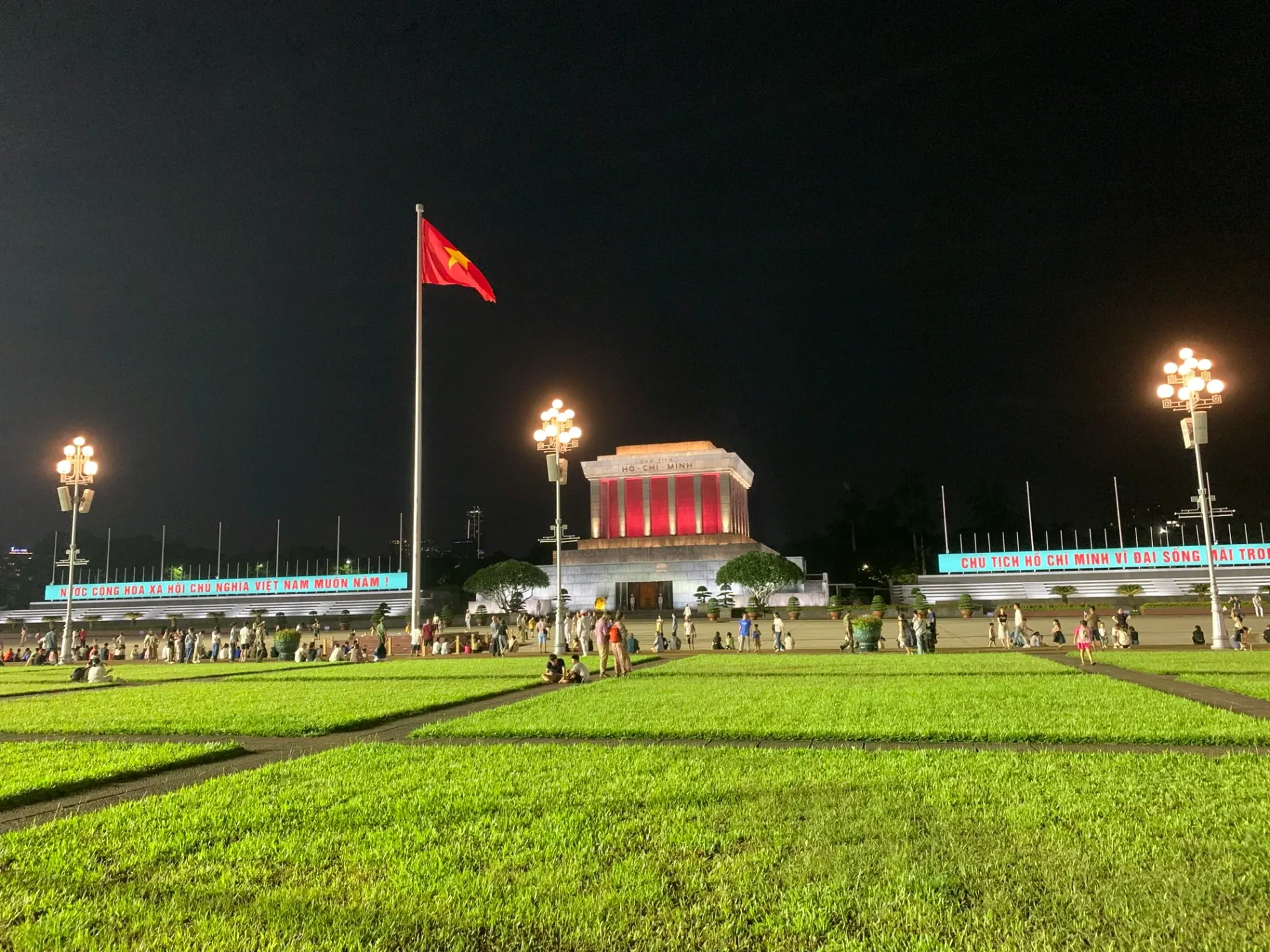
It stands tall, grey and massive beside Ba Đình Square, surrounded by green lawns, solemn guards and stories. Oddly calming, considering how much history this corner of Hanoi carries.
But before you turn up, there are a few things to understand. The visiting hours are short. The rules matter. And the mausoleum, the museum and the stilt house aren’t one attraction with one ticket.
What Is the Ho Chi Minh Mausoleum?
It’s a tomb. Yes. But also a national memorial, known in Vietnamese as Lăng Chủ tịch Hồ Chí Minh, or simply Lăng Bác.
Here lies Hồ Chí Minh, the revolutionary leader and president who proclaimed Vietnamese independence in Ba Đình Square on 2 September 1945. His embalmed body rests in a glass enclosure inside the mausoleum.
He died on 2 September 1969. His testament requested cremation, with his ashes divided between northern, central and southern Vietnam. The country’s leadership instead decided to preserve his body so people could pay their respects.
The mausoleum opened on 29 August 1975. That matters when you’re imagining the independence speech: the square was there in 1945, but this building wasn’t.
The stone exterior is imposing. Inside, the atmosphere becomes much more intimate. Whether you find it moving, unfamiliar or difficult to describe, remember that many people around you are here to pay tribute.
Plan Your Visit: Hours, Entry and Closures
You don’t just swing by the inner chamber whenever you fancy it. This is a morning visit, and the opening time changes with the season.
| Season | Tuesday, Wednesday and Thursday | Saturday, Sunday and public holidays |
|---|---|---|
| 1 April–31 October | 7:30–10:30 am | 7:30–11 am |
| 1 November–31 March | 8–11 am | 8–11:30 am |
Normally closed on Mondays and Fridays. The published schedule provides exceptions when 19 May, 2 September or the first day of Lunar New Year falls on either day. Special announcements can override the regular timetable.
Admission: Entry to the mausoleum itself is free. The neighbouring Presidential Palace historical site, including the stilt-house area, and the Ho Chi Minh Museum have separate admission arrangements. A ticket for one doesn’t mean you’ve paid for everything nearby.
Maintenance closures: Don’t assume the same two months apply every year. In 2026, the mausoleum reopened on 3 November after scheduled maintenance. Check the latest notice before arranging your morning around it.
Use the Mausoleum Command’s published schedule and announcements as your starting point. Arrive early in the visiting session, rather than treating the closing time as a target arrival time. Security screening and queues come first.
Time to allow: Keep a generous part of the morning free if you want to include neighbouring sights. The walk through the chamber is brief; the queue can be much longer. Weekends, school groups and commemorative dates can make a difference.
How to Get There Without Joining the Wrong Queue
The mausoleum faces Ba Đình Square on Hùng Vương Street, roughly 2–3 kilometres from many parts of the Old Quarter, depending on where you start.
A Grab car or taxi is straightforward. Walking is possible too, but allow for crossings, heat and the fact that the security entrance isn’t simply wherever the building looks closest.
Ask for the visitor entrance and queue for “Lăng Bác” and follow the signs and guards’ directions around the Ngọc Hà approach. Access can be managed differently for events. A map pin for the monument’s front isn’t always the best drop-off point for joining the line.
If you prefer a bus, check a current route planner from your accommodation. Don’t choose a route just because “Ba Đình” appears somewhere in its description.
Dress Code, Bags and Photography
First things first: dress for a formal memorial. A lightweight top covering your shoulders and trousers, or a skirt or dress covering your knees, are sensible choices. You can be comfortable without arriving dressed for a beach bar.
The official rules require neat, clean, respectful clothing. Follow staff directions if they ask you to adjust anything.
- Security: Visitors are screened and luggage must be deposited as directed. Small personal bags and valuables are permitted under the published rules.
- Phones and cameras: Phones and small tourist cameras may be carried switched off; professional cameras and video equipment must be deposited. Follow the screening staff’s instructions.
- Inside: No photographs or filming, smoking or chewing gum. Keep quiet, keep your hands out of your pockets, and don’t touch the walls or point.
- Food and drink: These aren’t permitted in the restricted visiting area. Plan your breakfast and water break around the visit.
- Queue: Stay in line, remove your hat as directed, and keep moving with the group.
- Young children: The published rules don’t admit children under two to the mausoleum.
The official visitor regulations also distinguish respectful souvenir photography outside from the ban inside the chamber. Don’t assume that permission to photograph the square extends to every part of the complex.
Travel light. Leave your suitcase at the hotel, keep any deposit receipt safe, and ask where to collect belongings before moving on. If you need step-free access or assistance with standing in the queue, contact the visitor office before travelling.
Inside: The Moment Hits Harder Than You Expect
The change is instant.
The noise fades. The air cools. The sunlight disappears.
You’re in. Surrounded by stone. By silence. Guards stand watch, and the line moves around the glass enclosure.
And there, under the controlled lighting, is Hồ Chí Minh.
It’s intense. You don’t necessarily expect it to feel so heavy. But it can.
You don’t stop for a long look or a conversation. You follow the route at the pace directed by the guards. The time inside is short—far shorter than the morning’s planning might suggest.
Then it’s over. You’re back outside. Back in the light.
For me, the quiet is what stays with the experience. You may react differently, and that’s fine too. There’s no particular emotion you’re required to have.
The Grounds and Nearby Sights Are Worth Your Time Too
Don’t rush straight back to the Old Quarter. The surrounding area gives the mausoleum more context—and a different pace from central Hanoi’s shopping streets.
Presidential Palace
Yellow colonial architecture. Big gates. A very different expression of power from the modest homes nearby.
The palace was built for the French governor-general. Hồ Chí Minh chose simpler accommodation in the grounds rather than making the grand building his residence. Today, the palace remains in official use; a visit to the historical site doesn’t mean you can wander through its interior.
Hồ Chí Minh’s Stilt House
Now this is a change of scale.
The wooden stilt house opened in May 1958. Upstairs are a workroom and bedroom; the open space below was used for work and receiving visitors. The fish pond and garden help explain why this part of the complex feels so different from the monumental square.
It’s a preserved historical home, rather than a house you explore room by room at your own pace. Follow the visitor route and take your time with the interpretation.
The Presidential Palace historical site’s account of the stilt house gives useful background on its construction and design.
One Pillar Pagoda
This small Buddhist shrine rises above a pond on a single pillar, its shape recalling a lotus flower.
Its origins go back to 1049 and Emperor Lý Thái Tông. The founding story involves a dream, but the structure you see today is a reconstruction after its destruction in 1954—not an untouched eleventh-century building.
Good for a pause. A breath. A respectful photograph where allowed. It’s still a place of worship, so give worshippers space and follow any posted restrictions.
Ho Chi Minh Museum
The museum is another separate stop, with displays about Hồ Chí Minh’s life and Vietnam’s revolutionary history. If the brief chamber visit leaves you wanting more explanation, this is where you can spend longer with the story.
Check its own opening hours and ticket information. The mausoleum being closed doesn’t automatically mean every neighbouring attraction is closed—or open.
A Simple Way to Plan the Morning
- Check the day before: Confirm the season’s hours, maintenance notices and your clothing.
- Visit the mausoleum first: It has the narrowest visiting window. Allow time for screening and queuing.
- Collect deposited belongings: Ask staff which route leads to the collection point before continuing.
- Choose your next stops: The palace historical site and stilt house, then the pagoda or museum, make a manageable continuation when their schedules allow.
- Leave room for a break: You don’t need to turn a reflective morning into an endurance event.
If the chamber is closed, you can still consider the surrounding sights and an exterior view where access is permitted. That gives you a worthwhile alternative without pretending it’s the same visit.
Is the Ho Chi Minh Mausoleum Worth Visiting?
Yes, if you want to understand what this place means to many Vietnamese people and you’re comfortable viewing an embalmed body.
For many, Hồ Chí Minh is Bác Hồ—Uncle Ho. The visit is an act of remembrance. You don’t need to share every political view to behave respectfully and pay attention.
If viewing human remains makes you uncomfortable, you can choose the exterior, historical grounds or museum instead. You aren’t doing Hanoi wrong by making that decision.
What makes the place memorable for me is the stillness. In a city that rarely gives your ears a rest, that counts for something.
So go, if it interests you. Show up early. Dress appropriately. And when you step inside, let it be quiet.
Sources and Further Reading
Alongside the official schedule, visitor regulations and historical-site link above, references include the Mausoleum Command’s account of the 1975 opening, Vietnam Law & Legal Forum’s account of Hồ Chí Minh’s testament, the government’s history of One Pillar Pagoda, and the November 2026 report confirming the mausoleum’s reopening.