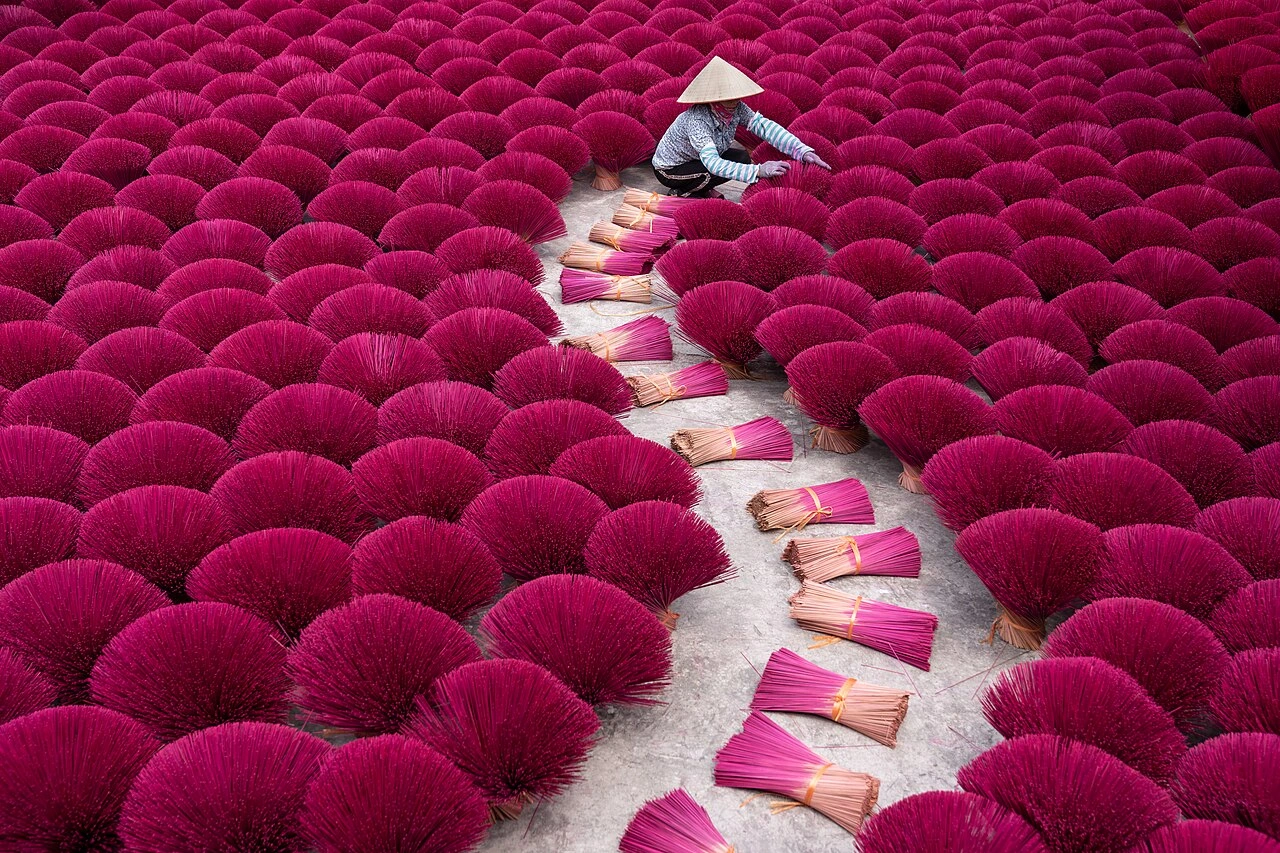
Go to Quảng Phú Cầu on a dry morning if your main reason for visiting is to see incense drying outdoors. Arrange your ride back before leaving Hanoi and ask a specific yard what it expects to be doing when you arrive. The familiar circles of pink and red sticks depend on the weather, the household and the work scheduled that day.
The village lies southwest of central Hanoi in the Ứng Hòa area. It works as a half-day outing if you go straight there and back. The Hanoi tourism portal pairs a morning visit with Mường Cốc on a longer itinerary. Its drive estimate applies to that itinerary. Allow extra time for traffic from your own pickup point.
Choose a working yard or a photography stop
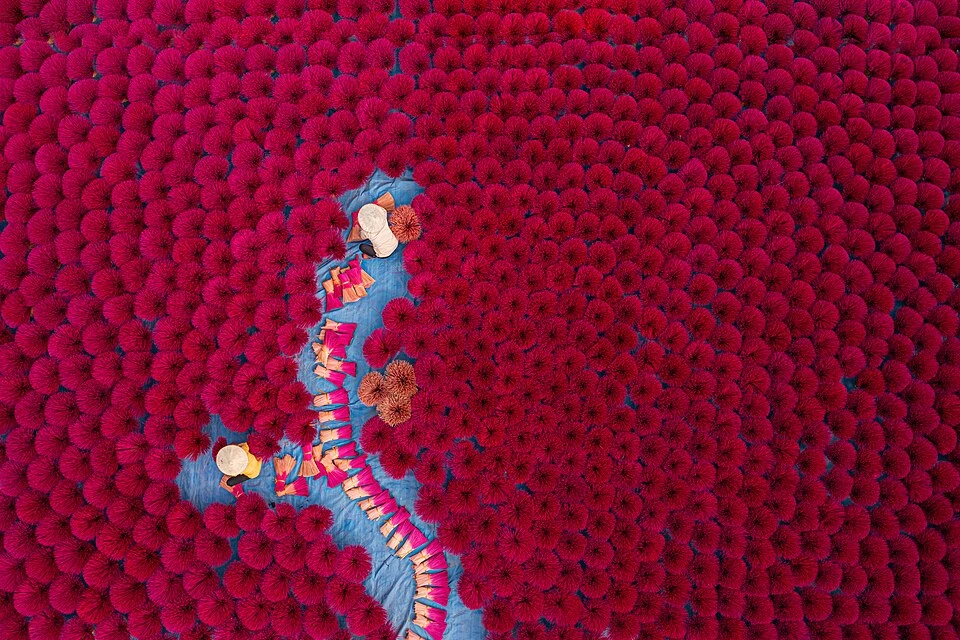
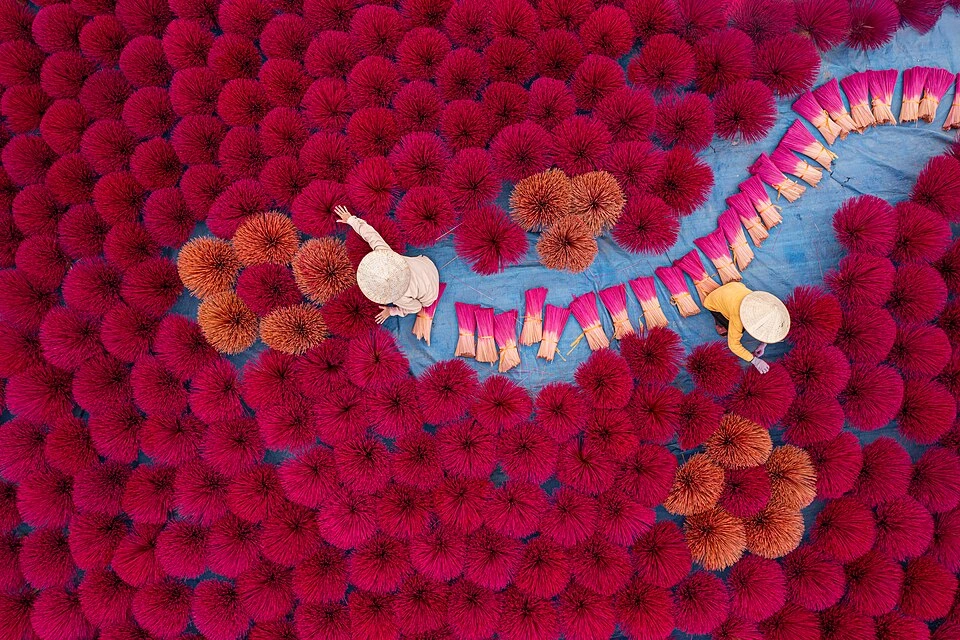
If you want to learn how incense is made, ask whether your host will show a production step such as sorting dyed stems, laying out bundles or preparing sticks for drying. The work you see depends on where the household is in its production cycle. For a photograph of the circular displays, ask whether the particular yard you intend to visit will have bundles laid out and whether visitors can photograph from ground level or a viewing platform.
Some yards are private workspaces. Confirm where visitors may stand, ask before photographing people, and keep the lanes clear when bundles are being moved. Agree on any entry, demonstration or photography fee with the host before you start. A fee quoted by one yard applies to that visit.
How to get there and back from Hanoi
For a short independent outing, book a driver for the round trip or agree on an exact return pickup. Send the driver your host’s map pin. The village name alone may bring you to a different lane or yard. Ask whether waiting, parking and any extra stops are included, and exchange a contact number or messaging details before you leave the car. Save the Vietnamese place name and your pickup pin offline.
A guided tour makes sense if you want interpretation or help arranging a workshop. Check whether the itinerary includes an actual demonstration, a scheduled photo stop or both. If you are considering a one-way ride-hailing booking, make sure you have a concrete return option from the village. Treat the inbound booking and the outbound pickup as two separate arrangements.
A simple morning plan
- Before leaving Hanoi: Check the forecast and ask your host whether drying or a demonstration is expected. Confirm the visit price, entrance pin and return plan.
- At the village: Start at the agreed yard. Ask your host what is happening that morning and where you can watch. Allow time for the demonstration if you booked one.
- Before leaving: Meet your driver at the agreed roadside location. Leave room in your schedule for the drive into Hanoi before booking a timed afternoon attraction.
If you have one full day in Hanoi, use the Monday opening guide to see what else fits that day. For another craft outing, compare the village’s drying-yard visit with the ceramics workshops described in the Hanoi Guides archive.
What to do if rain is forecast
Message the yard before committing to a ride. Ask two separate questions: will there be an outdoor display, and is there an indoor activity if the sticks stay under cover? A demonstration can make a wet visit worthwhile if your interest is the craft. If the photograph is the whole reason you are going, keep the morning free to switch plans. A dry forecast gives you a better chance of seeing the outdoor process, and a reply from the host tells you what that household expects to do.
Choose the visit you actually want to book
There are three different experiences under the name incense village. You can visit an arranged courtyard for photographs, watch a household carry out a stage of work, or book a guided craft outing that includes a demonstration. The bookings sound similar when a listing only promises a visit to Quảng Phú Cầu. Start by asking the host to describe what you will physically do after arriving. An answer that names a courtyard, a person who will receive you, and a task you can watch is easier to plan around than a promise that the village will be lively.
For photos: Choose a courtyard that receives visitors and ask whether the bundles will be outside during your window. Find out if your entry includes an elevated viewpoint and if the host limits time on it when groups arrive together. Large displays can look different from ground level. If someone in your group prefers to stay off ladders or steps, confirm a ground-level view that works for them before buying tickets or arranging a driver.
For the craft: Ask which stage your host expects to show. Sorting stems and handling drying bundles are different from watching a finished stick being rolled or packed. A short arranged demonstration can be worthwhile even when regular production is happening somewhere else. Ask whether someone can explain the stage in a language you understand and whether you will observe or try it. Give the host your group size so they can say whether their space is suitable.
For a combined visit: Hanoi’s tourism portal describes a day that starts among the drying yards and continues to Mường Cốc. Treat that as an example of what an organised outing can cover. Check whether the actual operator serves both places on your date, when you will have lunch, and how long you will spend at each stop. If seeing incense production is your priority, protect that slot before adding a second village.

Where to put the pin
Quảng Phú Cầu is a craft area with several settlements associated with incense. Vietnam Airlines gives the Cầu Bầu area on Road 429 as one reference point and traces the craft from Phú Lương Thượng to neighbouring villages including Đạo Tú and Xà Cầu. Vietnam News Agency’s reporting uses the newer Ứng Thiên commune name. A booking may use either older or newer administrative names. For a visitor, the entrance pin sent by your host is the most useful detail. Ask for the name of the yard in Vietnamese and keep it beside the pin, so the driver has two ways to locate it.
A pin at a workshop door may lead down a lane where a large car cannot wait comfortably. Ask for a separate roadside meeting point if you will have to walk back to the car. If you are meeting a guide, decide who walks to whom when you arrive. A screenshot of the intersection and a message that says which side of the main road to wait on can save a round of calls. Ask the host about the final surface and distance if you are bringing a stroller or someone has difficulty walking.
For context, see Vietnam Airlines’ directions to the craft area and Vietnam News Agency’s reporting on the craft before Tết.
Use a rain decision before you pay for the drive
A shower changes the visit in two ways. It can remove the outdoor scene you came to photograph, and it can change where visitors are welcome while staff move the bundles. Ask the host about drying conditions in the village itself. A clear view out of your hotel window tells you little about what the yard has laid out. Yesterday’s rain can also matter if the ground is still wet or the household has rescheduled its work.
Use three possible replies to decide. If the yard says the bundles are out and will remain accessible during your visit, confirm the arrival time and leave. If outdoor work is unlikely but the host offers a specific covered activity, ask what it involves, how long it lasts and whether it carries a separate fee. If the only answer is that the village is open, and outdoor photography is your reason for going, hold the ride until you have a clearer answer or use that morning in Hanoi.
One point of contact is Incense Village Hanoi, a private tour operator whose guide explicitly discusses rain and workshop visits. Ask the operator to confirm the host, the production stage and the covered alternative for your date. If the operator can arrange a stop in Xà Cầu, ask for the cooperative or household name and the exact meeting point. Treat a specific visitor slot as confirmed once you have the time and the host’s contact details.
What the price should include
Compare quotes by writing down the items that can be charged separately. Begin with the vehicle, tolls, waiting time and any surcharge for a second stop. Add the courtyard entry, the demonstration if you booked one, optional photography services and food. An independent local operator publishes an example price of 50,000 VND per visitor for an arranged photo courtyard. That is the operator’s published example, so ask your chosen yard how much it charges and whether it is cash only. Published fee example
If the quote says admission included, have the organiser name the included courtyard and clarify what happens if that courtyard is closed. If you are paying a household directly, confirm whether the amount is per person or per group. Couples and groups should also check whether everyone pays to enter an elevated viewpoint or whether anyone who wants to remain downstairs can wait nearby. Bring small notes if the host requests cash and ask before agreeing to a posed photo or an outfit rental.
A message you can send the day before
Give the host enough information to answer in a single reply. In English, you could write: “Hello, we are [number] people planning to arrive at [time] on [date]. Will incense be drying outdoors then? Can you show us a step in making it under cover if it rains? Please send the entrance pin, the price per person and the best place for our car to pick us up.” If photography matters, add whether you want to photograph the process, the arranged display, or both.
For the two weather questions in Vietnamese, you can use Sáng mai có phơi hương ngoài trời không? to ask whether incense will be drying outside tomorrow morning and Nếu trời mưa, có thể xem làm hương trong nhà không? to ask whether you can watch incense being made indoors if it rains. For the pin, Xin gửi vị trí cổng vào asks for the entrance location. Replace tomorrow morning with your date and time if the visit is further away.

What to look for while you are there
Ask your host to point out which bundles are prepared stems and which are finished incense. The bright red or pink ends are the part that catches the eye in the yard. A closer look at a finished stick gives you a way to ask where the aromatic material goes and how the household checks its work before packing. One visit may only show a single step. Learning where that step sits in the sequence gives you more context than spending the entire stop on the viewing platform.
If you buy incense, ask the seller to identify the scent and show you the finished packaging. Ask whether the pack includes instructions for use and storage, and check your destination’s rules before carrying plant-based material across a border. If anyone in the group is sensitive to strong smells, ask whether the demonstration involves burning a sample. They can decide whether to stay outside or arrange a shorter visit.
When photographing, let working people move through first. Stand where the host shows you, especially at the edge of tarps and around the narrow paths between rows. Get permission for close portraits and ask before changing the position of any bundle. A wide frame gives you the scale of the work. A second photograph from the permitted path can show how the bundles are tied or where the stems change colour. Both can be taken without asking anyone to stop working.
Two half-day itineraries
Dry morning: Begin with the courtyard while your host expects the display to be out. Then move to a demonstration if you arranged one, and leave time between stops if they are in different lanes. As an illustrative schedule, a yard appointment at 9:30 and a pickup at 11:15 leave room for a short demonstration or a second view of the same courtyard. Work back from the yard appointment using your driver's estimate from your actual hotel. Schedule your first fixed appointment in Hanoi with room for the drive back and lunch.
Unsettled morning: Make the indoor visit the anchor. Arrange a clear go-or-cancel point with your driver before leaving, and only add the courtyard if the host confirms that it is open to visitors and has something you want to see. If your plan is mainly photography and the bundles will be under cover, spend the morning on an indoor stop in Hanoi. Check the Monday opening guide if the weather forces a last-minute change at the start of the week.
For either version, leave Hanoi with three details you can show on your phone without internet: the workshop entrance, the agreed return meeting point and the name or number of the person receiving you. Add those details to a screenshot with the time and quoted total. When you reach the village, let the host know when you need to leave. That gives them a chance to suggest which activity fits the time you have left.
Photo credits
- Cover: Vietsui, Incense in Vietnam, CC BY-SA 4.0.
- Azimronnie, Drying incense 01, CC BY-SA 4.0.
- Azimronnie, Drying incense 04, CC BY-SA 4.0.
- Azimronnie, Drying incense 36, CC BY-SA 4.0.
- Azimronnie, Drying incense 32, CC BY-SA 4.0.
All photographs via Wikimedia Commons, displayed at reduced size.