At the south end of Hoàn Kiếm Lake, it’s tempting to keep following the water. I’d turn onto Tràng Tiền here. The distance to the Opera House is short enough that you can spend the walk looking up instead of checking how far you still have to go. Follow Tràng Tiền east and the Hanoi Opera House comes into view across August Revolution Square. Between the lake and the theatre, there’s enough to see in the shopfronts and façades to make the walk worthwhile even if you never go inside a building.
If you’re fitting this into a wider day in Hanoi, make the Opera House your finish. If you have time for coffee or another look at the architecture, return to the lake via the Metropole.
Hoàn Kiếm Lake to the Opera House on foot
Start: The Tràng Tiền end of Hoàn Kiếm Lake. Use Tràng Tiền Plaza as the meeting pin if you’re coming separately. Finish: August Revolution Square, outside the Hanoi Opera House. Allow: About 25–40 minutes for the short walk with photo and crossing stops. That’s a planning estimate from a local walking-tour operator. Set aside extra time if you’re returning via the Metropole or going indoors.
Open the lake-to-Opera House walk in Google Maps · Source for the walking estimate
- Start at the south end of Hoàn Kiếm Lake. If you’re coming from the Old Quarter, follow the lakeside path south until you reach Tràng Tiền. This is where the French Quarter walk begins. See the Hoàn Kiếm Lake guide if you want to walk around the lake first.
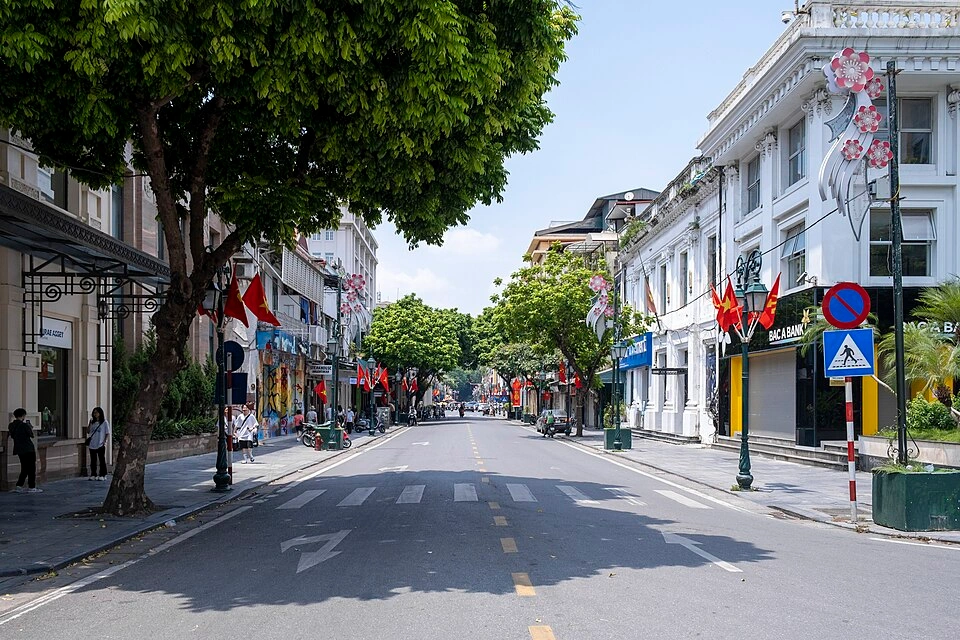
- Follow Tràng Tiền east. Look back toward the lake before continuing. The change in street scale is part of the route: the longer façades and wider junctions feel different from the narrow shopfronts north of the lake. Use marked crossings where available, and watch for turning traffic at the larger junctions.
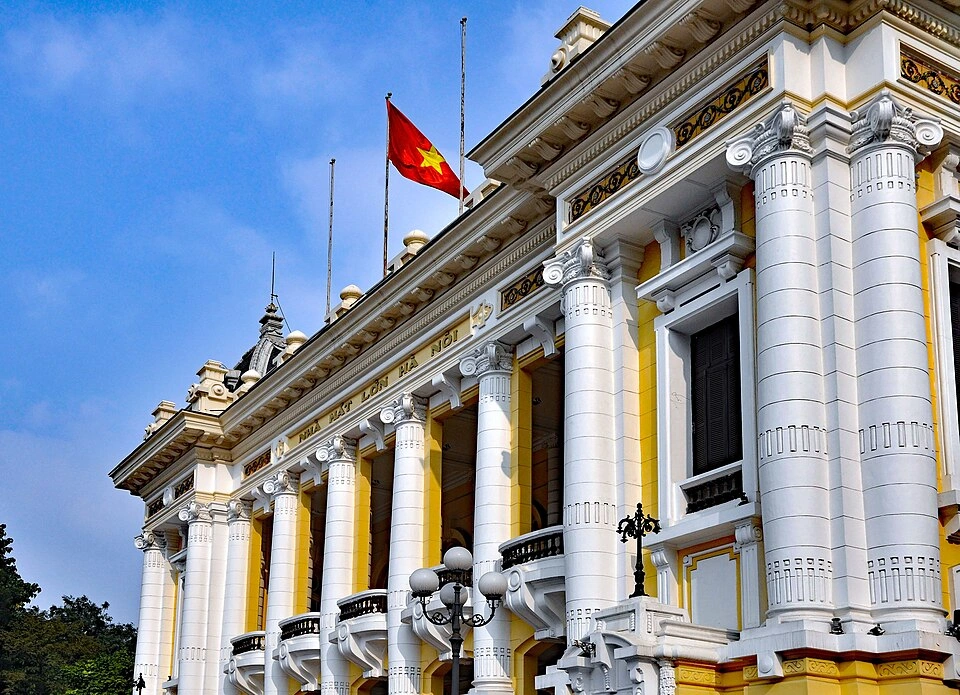
- Finish at the Hanoi Opera House. Stop on the public pavement at August Revolution Square to take in the front of the building. Look for the columns and balconies above the entrance. Leave the larger square crossing out of your walk if the view from the approach is enough for you.
What to look for along Tràng Tiền
Pick something to look at on each stretch so this feels like a walk through a neighborhood. Near the lake, look at the shopfronts at eye level. Farther along Tràng Tiền, look above the signs to see how the upper storeys and balconies change. At the Opera House, stand back far enough on the public pavement to see how the columns frame the entrance. You can get a useful view from the approach without crossing the entire square.
If you’re taking photos, start with a wide street view and then pick one detail. A closer frame of a balcony or doorway can show something the wide photo misses. Keep moving if a building entrance or narrow pavement gets busy.
At the lake end, compare the corner with the rest of the street
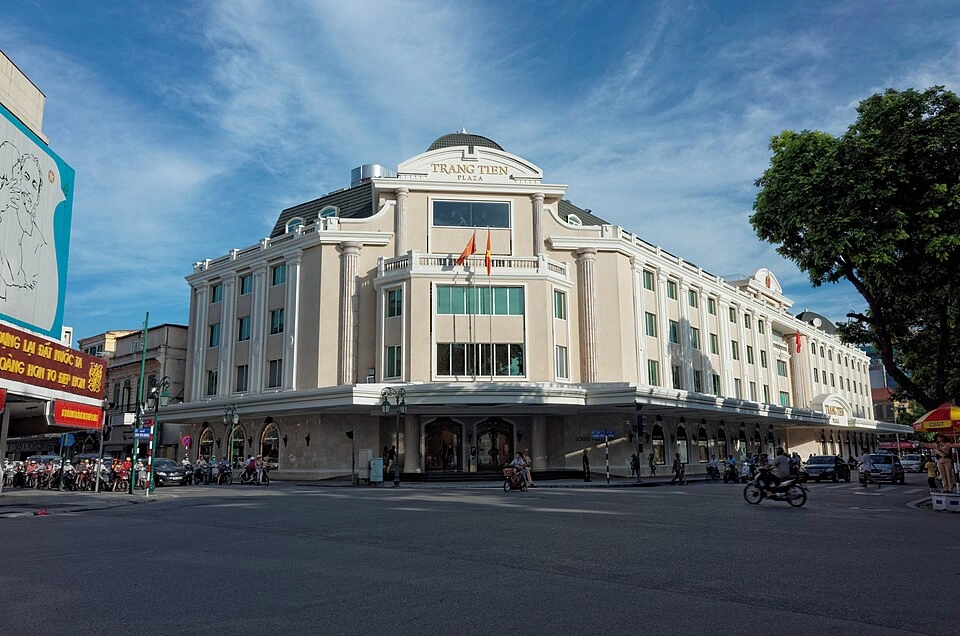
Use the outside of Tràng Tiền Plaza as the first place to get your bearings. Stand where you can look along the street, then look back towards the water. The change in scale is more apparent when you have both directions in mind. As you walk away from the lake, notice how a corner building announces the turn, while the shopfronts farther along serve people walking straight past. If you have only one photograph in mind, take it after you’ve looked in both directions. A corner view can show the street and the building together.
On Tràng Tiền, look above the ground-floor signs
Start at eye level. The doors, shop signs and people coming and going tell you what the street does today. Then look up. Repeated window openings, railings, balconies and the way a roofline meets the next building make it easier to compare one frontage with another. Some façades have changed with new uses and shop fittings. The details you can see are good prompts for questions about the buildings. They’re a poor basis for assigning a date to every property you pass.
Take the comparison slowly enough to notice the contrast between an ordinary frontage and the formal approach to the theatre. If you’re walking with someone who isn’t interested in architecture, try picking one feature each. For example, one of you can look for how buildings mark their entrances and the other can look at balcony railings. That gives both of you something to notice without turning the afternoon into a lecture.
Can you go inside the Hanoi Opera House?
Plan the walk around the exterior. If you want to go inside, check the programme and admission arrangements for the date you’re visiting. Also check the venue name before buying a ticket. The historic Hanoi Opera House is on Tràng Tiền, while Hồ Gươm Opera is a separate venue on Hàng Bài.
Vietnam Tourism’s Hanoi Opera House listing · Vietnam National Symphony Orchestra venue listings
Know which opera house is on your ticket
For the façade in this walk, save Nhà hát Lớn Hà Nội at August Revolution Square, at the Tràng Tiền end of the route. For a ticketed performance, search using the exact venue and address on the booking. The Hồ Gươm Opera contact page identifies its theatre on Hàng Bài. If a booking page only says “opera” in English, ask the organiser to confirm the venue before you decide where to eat or meet friends.
At the historic Opera House, the feature I’d spend time on is the relationship between the front of the building and the square. Take in the composition from the public approach. Look for which entrance the columns draw your eye towards and how the balconies sit above it. You can see more of the overall shape by stepping back where there is room on the pavement. If you have tickets, leave time to find your assigned entrance and confirm any admission or bag instructions for your event.
A longer return via the Metropole
From the Opera House area, head toward Ngô Quyền to see the exterior of the Sofitel Legend Metropole Hanoi. The hotel is a good second architecture stop because you can compare its street frontage with the Opera House’s more formal approach across the square. Then return toward the lake. A café stop is optional, so you can make this a longer walk without committing to another ticket or tour.
Vietnam Tourism’s longer Hoàn Kiếm and French Quarter walk
Use Ngô Quyền to compare two kinds of entrance
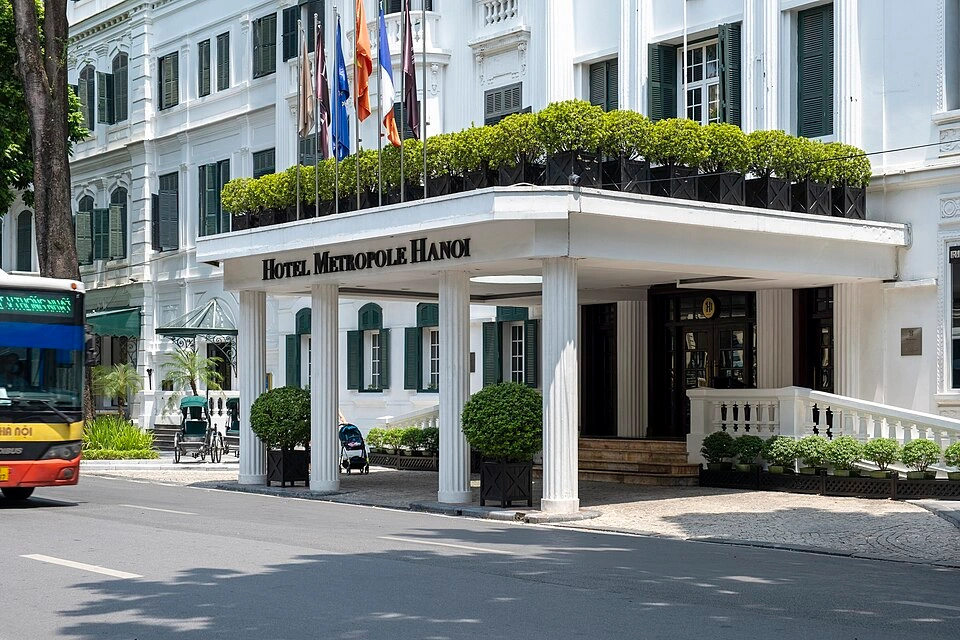
The hotel’s own history dates its opening to 1901 and places the original property at a corner on today’s Ngô Quyền Street. This is an active hotel. Stay on the public pavement for the exterior view and leave the doorway clear. If you intend to sit inside or join a hotel programme, check whether a reservation or guest status applies to the specific space you want.
Where the theatre faces a square, the hotel meets the street much more directly. Look at what frames the hotel entrance and how the frontage turns the corner. It’s an easy comparison to make while the Opera House is still fresh in your mind. To finish by the water, send your map back to the Tràng Tiền end of Hoàn Kiếm Lake and use the return for a final look at the shopfronts from the opposite direction, where crossings allow.
If you want to add the National Museum of History
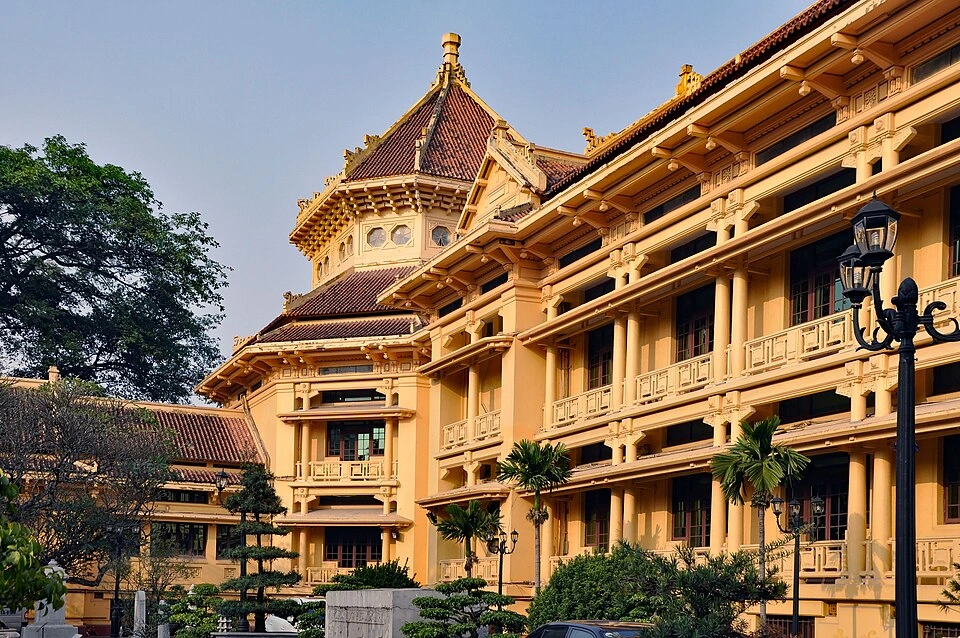
Check the exhibition address before heading there. The museum announced a renovation closure of the permanent exhibition at its 1 Tràng Tiền site starting December 15, 2025, and said its 216 Trần Quang Khải site would remain open during the work. Consult the museum’s latest information for your visit date before adding it to your route. See the History Museum guide for the open building, hours and a suggested visit.
Read the museum’s renovation notice
The published visitor page still lists both addresses. The museum’s September 2026 holiday notice directed visitors to 216 Trần Quang Khải. I found no reopening notice for the permanent exhibition at 1 Tràng Tiền when checking in November 2026. Ask which galleries are receiving visitors before buying a ticket or setting out. If you want to make the museum your main visit, choose the building by the period you want to see and check the opening window and any midday break for that building.
Where to finish the walk
- Short on time: End at the Opera House. If your next stop is back around the lake, retracing Tràng Tiền is the simplest return.
- Want another architecture stop: Add the Metropole exterior. Keep the coffee break optional so the return still works if you’d rather stay outdoors.
- Want an indoor visit: Pick one museum or performance and check its hours or showtime separately. Treat that as an addition to the walk, with its own time and admission.
Choose the pace before you start
For the shortest version, make the Opera House exterior your finish and give yourself time to get back separately. If you’re doing the Metropole return too, plan a little more time for the detour and for waiting at crossings. If you’ve added a timed performance, start from that arrival deadline and work backwards. You can always leave the return walk for another day when you aren’t watching the clock.
If it’s bright enough to see the façades clearly, I’d do the architecture route during the day. After dinner, the short stretch from Tràng Tiền to the Opera House works as an evening stroll, and the weeknight guide has alternatives when your group wants a show or a seated finish. If it’s raining heavily, choose a confirmed indoor destination and give the exterior walk the next usable patch of daylight. A low cloud ceiling changes the light on the buildings, but the crossings and the comfort of the group are the better reasons to shorten the route.
A simple way to photograph the route
Make a set of three pictures if you want the photographs to tell you something about the walk afterwards. Start with a wide view at the lake end, then photograph one entrance or balcony along Tràng Tiền. At the Opera House, take a wider picture that includes some of the square. If you return via the Metropole, make a fourth picture that shows how the hotel sits on its corner. All of these can be taken from public space when there is room to stop.
In a group, agree on a meeting point beyond a junction before anyone stops to take pictures. If others have already crossed, let them know you’re still on the first side rather than rushing to catch up. A view of the theatre framed by the street can work even when a perfectly centred picture would require a crossing you’d prefer to avoid. If you need to sit or use a toilet, make that part of your route before leaving the lake, rather than relying on the theatre or hotel to admit someone who hasn’t booked.
French Quarter walking questions
Do you need a ticket for the walk?
The route uses public streets, and you can see the main façades from outside. Check admission separately if you plan to enter a museum or attend a performance.
Can you combine this with the Old Quarter?
Yes. Walk the Old Quarter first and use the lake to connect the two areas. Start this route at Tràng Tiền instead of repeating the whole lakeside circuit.
Is the walk suitable if I need an easy crossing or a rest?
The route is short, but the large junctions affect how easy it feels. Use marked crossings where available, allow extra time, and finish from the near side of the square if crossing it adds more effort than you want. I wouldn’t promise a continuous step-free route without checking the pavements in person.
Planning the rest of the day? Browse Hanoi’s neighborhoods or see how a walk around the lake fits into a one-day Hanoi itinerary.
Photo credits
- Hanoi Opera House by P. Hughes, CC BY 4.0. Resized.
- Tràng Tiền Street by The Hanoian, CC BY-SA 4.0. Resized.
- Tràng Tiền Plaza by blue_quartz, CC BY-SA 2.0. Resized.
- Metropole exterior by The Hanoian, CC BY-SA 4.0. Resized.
- National Museum of History by P. Hughes, CC BY 4.0. Resized.